Salt Marshes
Saltville was named for its inland saline marshes. Those brackish waters and salt licks drew wildlife, Indigenous hunters, and later European settlement into the valley.
A Frye family sketch
A family history centered on the Virginia mountains, the salt town of Saltville, and the Frye line that runs through Smyth County.
The family name
The name appears in the records with the kind of spelling drift that belongs to older families: Fry, Ffrie, and eventually Frye.
Family names were not always fixed in the way we expect now. Clerks wrote what they heard, families adapted spellings across counties and generations, and old forms could survive beside newer ones. In the tree materials gathered here, the line begins with Thomas Frye or Ffrie in Basing, Hampshire, England, and then passes through John Ffrie before the Frye spelling becomes more familiar in Massachusetts and Virginia records.
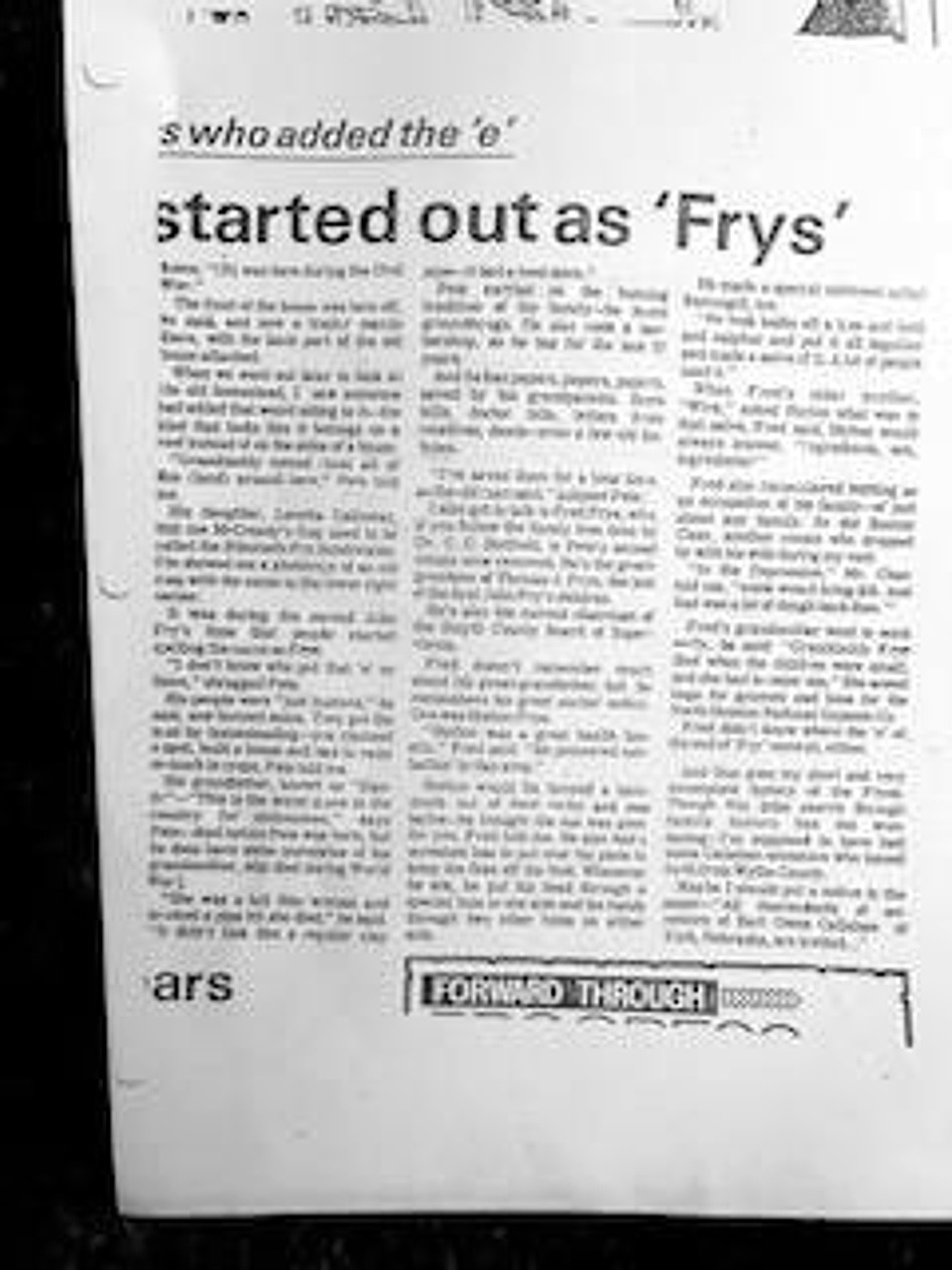
The surname is commonly treated as English or Anglo-Saxon in origin, often connected with the idea of a free person or freeborn status. A family newspaper clipping preserves the plain-language mystery too: the family "started out as Frys," and no one in the article was quite sure where the added "e" came from.
Saltville sits in Smyth and Washington counties, tucked into the Appalachian valley and ridge country. Its story is much larger than its size: salt marshes, fossils, Native paths, Civil War saltworks, company-town industry, and now heritage travel.

Saltville was named for its inland saline marshes. Those brackish waters and salt licks drew wildlife, Indigenous hunters, and later European settlement into the valley.
During the American Civil War, Saltville was one of the Confederacy's main saltworks. Salt preserved meat for soldiers and civilians, which made the town a target.
Union forces attacked Saltville in October 1864 and again in December 1864. The second attack destroyed the saltworks, a serious blow to Confederate resources.
The same salt lick that drew animals also preserved evidence of deep time. Mastodon, woolly mammoth, giant ground sloth, musk ox, stag moose, and other Ice Age remains have been found in the Saltville Valley.
The Saltville Well Fields are now known for brackish wetlands, migratory birds, wildflowers, paleo-archaeological digs, and walking routes near old salt wells and research sites.
Modern Saltville leans into its unusual past through the Museum of the Middle Appalachians, the Salt Theater, the Salt Trail, the wave pool, outdoor recreation, and small-town events.
What sounds like a tar pit in family memory is more accurately Saltville's fossil-rich salt lick and well fields. The valley's salt deposits attracted animals for thousands of years, and the wet, mineral-rich landscape helped preserve traces of an Ice Age world.
Today, visitors can follow that story through the Museum of the Middle Appalachians, whose exhibits frame the region as a passage from the Ice Age to the Space Age. Nearby, the Well Fields and Salt Trail make the history walkable: birds overhead, old salt works underfoot, and the mountains holding the town in place.
A working line from the tree
The PDF tree begins with Thomas Frye/Ffrie of Basing, Hampshire, England, then John Ffrie, then Samuel Ffrie of Andover, Essex, Massachusetts.
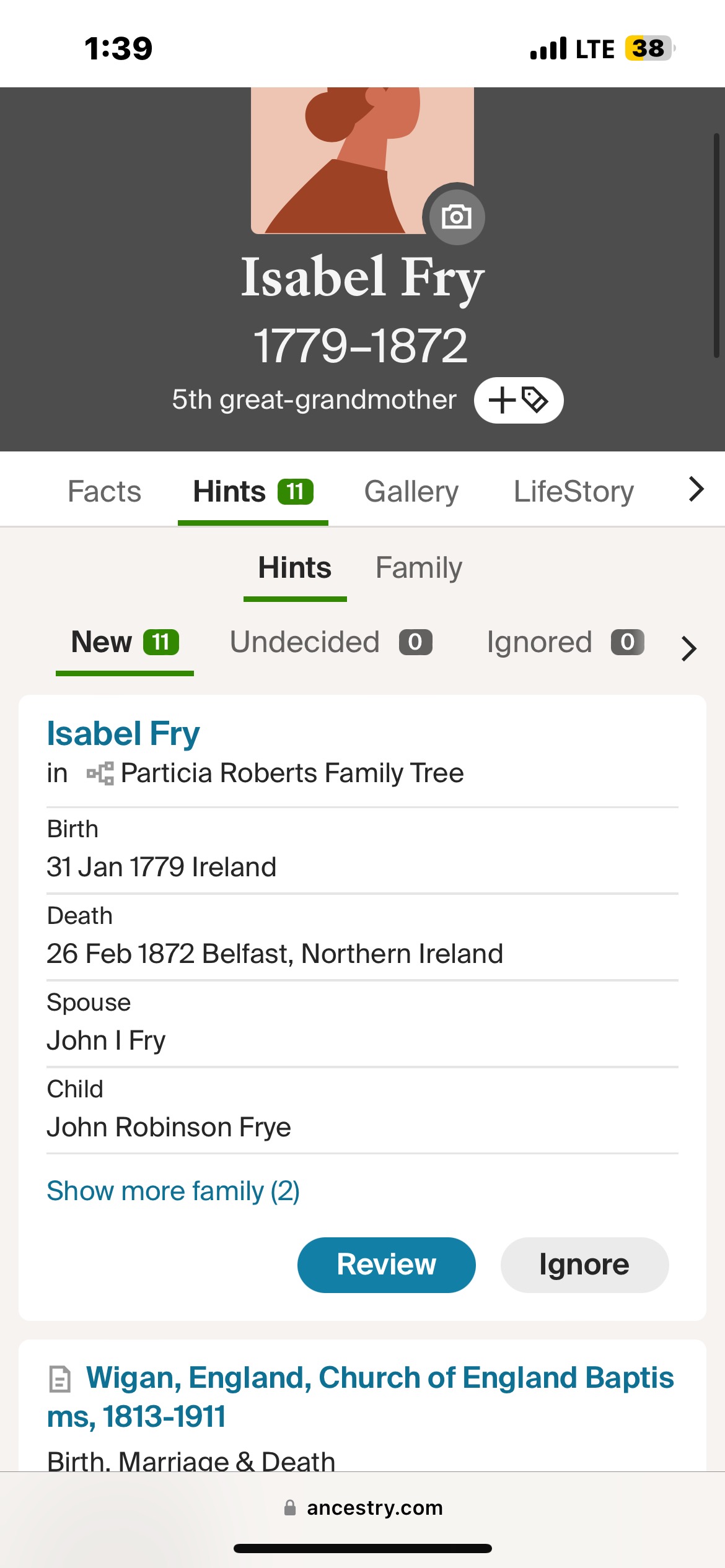
The tree shows John Fry, born in Wilton, New Hampshire, and Isabel Fry, born in Ireland. Their child John R. Frye is listed as born in Belfast, Antrim, Ireland and dying in Saltville, Washington County, Virginia.
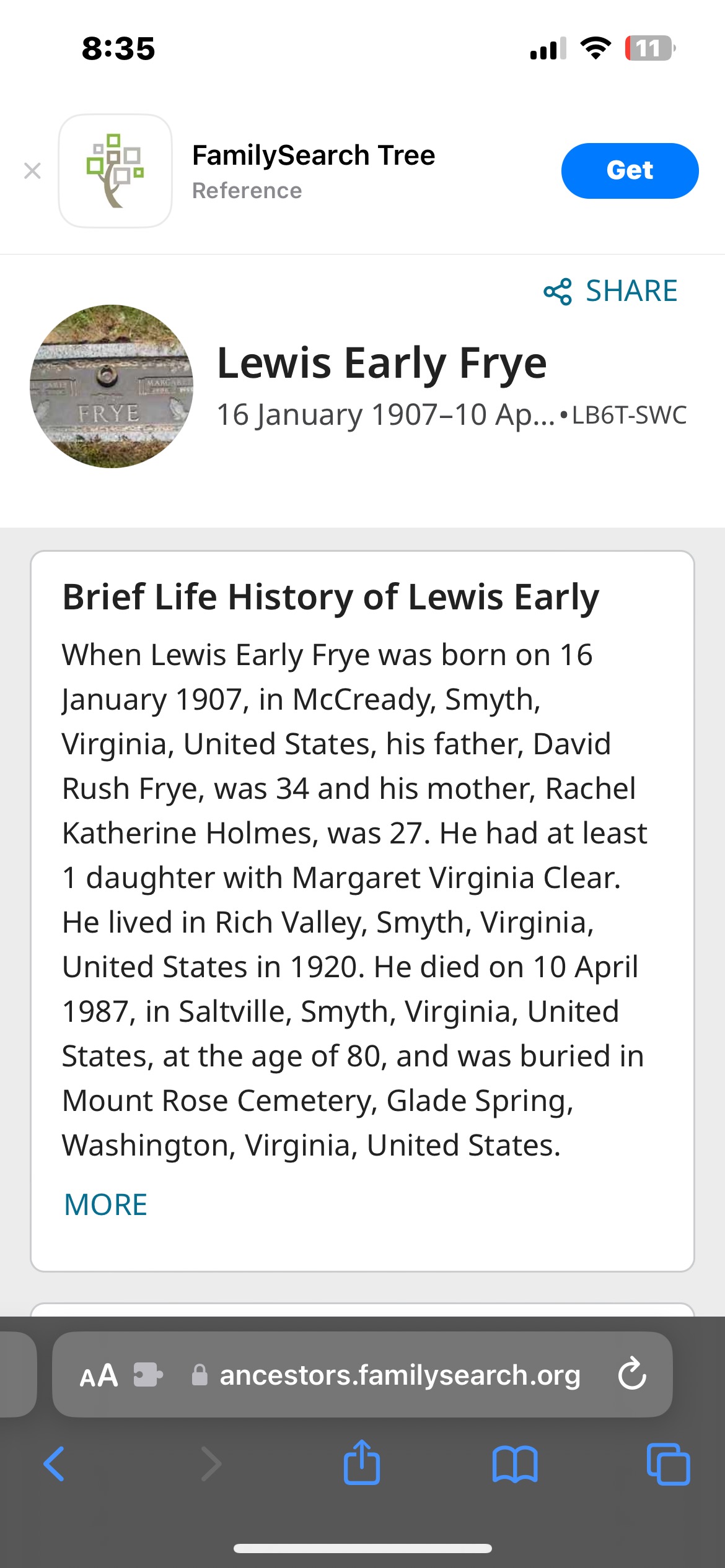
John R. Fry and Elizabeth A. Fry are followed by David Rush Frye, born in Saltville in 1872, linking the family story firmly to Smyth County and the salt town.
William Fielding Frye and Hazel Gertrude Barnett stand near the center of the recent family memory. The tree then leads to Edward Frye, born August 1, 1949 and died December 24, 2003.
A newspaper article remembered the family as beginning as "Frys" and wondered who added the "e." Its family memories are earthy and local: farmers, horses and mules, corn, cotton, tobacco, gardens, hunting, big meals, plant knowledge, and a Germany tradition attached to an older Fred Fry or Frye.
Sources and acknowledgments
This page brings together family tree materials, family-supplied screenshots and clippings, and public history sources about Saltville, Virginia. It is meant as a living family history: rooted in the records we have, open to new details as more stories and documents surface.
